
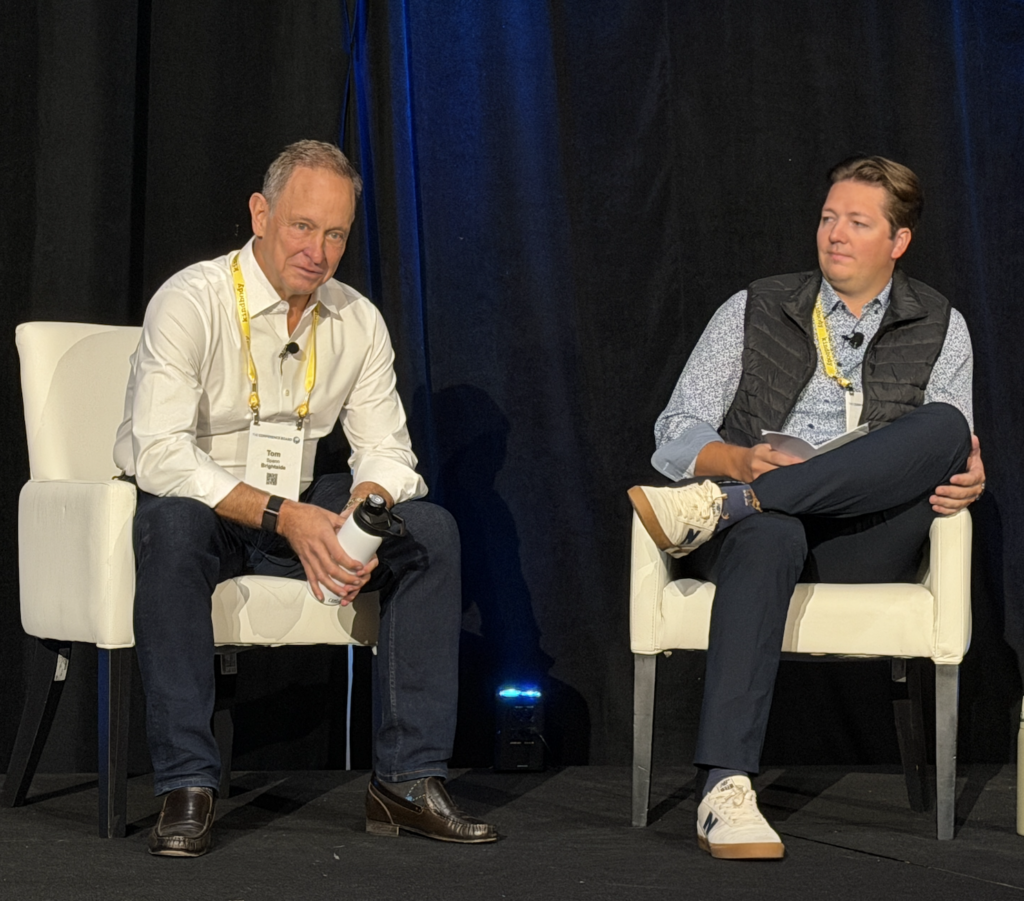
At The Conference Board’s Employee Health Care Conference in Chicago last week, Jack Nickel, Amazon’s Global Financial Wellness Program Manager, and Tom Spann, Brightside’s CEO and co-founder, presented a session based on a number most benefits strategies never touch: the unaddressed 30% of healthcare costs driven by poor financial health.
How Amazon approaches financial health
Nickel started by explaining that, like many employers, his team serves two distinct employee populations: hourly fulfillment-center roles and salaried corporate jobs. As a result, Amazon’s benefits “cannot be one-size-fits-all.” It’s imperative to “meet people where they’re at, not where we assume everybody’s going to be.”
His team manages 25 financial health programs across four pillars, roughly Maslow’s hierarchy of needs applied to financial health.
The employee is the center of their focus, and decisions are data-driven. “No single program can solve financial health,” said Nickel. “All of our programs have to work in concert, and that’s a delicate balance that we look at: how do we deliver these solutions at the right time to the right people?”
Where financial stress meets healthcare costs
Why does financial stress belong in a healthcare conversation? Spann made the connection directly: “It’s the biggest cause of stress. It affects every system in your body. Mayo Clinic released a study that said poor financial health is as bad for your heart as smoking. So it’s making these people sick, and it’s keeping them from getting better.”
Drawing on his experience as founding CEO of Accolade, Spann said the vast majority of people coming in the door had some nonclinical reason they weren’t getting the right care. Most often, that reason was financial.
Ultimately, unresolved health issues mount and end up becoming more expensive and more severe to treat.
The problem Amazon set out to solve
Asked what problem Amazon in particular was trying to solve, Nickel pointed to what he called the financial triage.
“If someone breaks their arm, everybody in this room knows you go to the ER,” he said. “But if an employee can’t pay their credit card this month, gets evicted, has a death in the family that is the breadwinner, what do we tell them?”
The honest answer, he said, was a list of point solutions and a referral. “It was ‘talk to the EAP’ (and I’m not dissing the EAP); they’re fantastic at what they do. But they’re not finance. They’re therapy. We had to find a way to solve that gap.”
The problem isn’t confined to a small slice of the workforce. “Financial stress is the number one source of stress for working Americans,” Nickel said. “70% of working Americans are not financially healthy. It shows up in a distracted, less productive, more likely to leave or get hurt population.”
He added that it’s not a compensation issue; it’s about financial complexity. “Financial shocks and financial stress do not discriminate on income.”
Why existing programs miss
The benefits landscape isn’t short on financial offerings. The problem, Nickel argued, is who they’re built for. “Point solutions have a time and place. They are a tool, but they’re not the carpenter.”
He noted that education and planner-based programs can serve the 30% of people who are already stable and want to make their money go further, but “we need to serve the 70%.”
Nickel added that while most employers have a 401(k) provider who will offer financial services for those ready to talk to a financial advisor about making their money go farther, they can’t stop the credit card debt from snowballing, or help someone who has just been diagnosed with cancer or just can’t pay their bills. “Those are the solutions we needed to tackle. So it was trying to find a product that fit that gap.”
Spann recalled a PwC survey from Brightside’s early days that captured the gap between what employers think employees need and what employees actually want. The employers surveyed said their people needed a financial plan. The employees said, “I need to know what to do now and what to do next.”
Spann added that often, people “need hope more than anything else — and real solutions help that a lot.” That’s why part of Brightside’s model is founded on behavioral science and instilling hope.
“Behavioral science works,” said Spann. “Billions of dollars are spent every day making it easy for your employees to do the wrong thing with their money. We’re just trying to use that same behavioral science to make it easy to do the right thing.”
Driving engagement by meeting people where they are
When asked how Amazon drives benefits engagement, Nickel pushed back on the standard playbook. “You can’t wave the flag and say ‘come learn about your benefits.’ You’ve got to start with the person and their problem — what keeps them up at night — and meet them where they’re at.”
In practice, that means reaching employees at the moments financial decisions actually happen — when they most need help and are most at risk of a poor choice driven by financial stress.
He added that integrating financial support with the rest of the benefits ecosystem also helps with a problem every benefits leader knows — underutilization. It creates a space where, no matter how someone needs help, you have something for them.
What works: a person, trust, and hope
When Amazon initially launched Brightside, the team studied its population first, piloted, and measured before expanding. “We found a real impact on safety, attendance, productivity, retention — measurable, tangible impacts on the business,” said Nickel.
When asked what helped move the needle on those outcomes, Nickel pointed to the support of a real person. “Money is inherently shameful in this country, and having money issues is even more so. But having a person they [employees] can talk to — the same person, so they don’t have to re-explain their case — creates that trust. It keeps people coming back.”
Spann added: “Trust is the currency of the business. These people won’t engage if they don’t trust us. We’ve got to earn it. We’ve got to be on their side. You can’t be making money off of products.”
The session ended where it began: financial stress isn’t a personal failing at the edge of the benefits conversation. It’s a measurable driver of health, safety, retention, and cost. As Nickel put it, “It is our problem to solve.”
Brightside Financial Care is the benefit that helps Amazon and other Fortune 500 employers solve it. Schedule a demo with our team to learn more about how it works.